|
Annual
Report - 2023
REPORT OF THE NEW YORK STATE AVIAN RECORDS COMMITTEE
FOR 2023
The New York State Avian Records Committee (hereafter “NYSARC” or the “Committee”) evaluated 60 submissions involving 49 occurrences of New York State review species from 2023, as well as three formal submissions from previous years. The Committee also evaluated more than 2,500 eBird checklists involving 100 occurrences of New York State review species from 2023. Total occurrences of New York State review species were 149 with 39 of the 62 counties represented, plus the pelagic zone.
The Committee also continued its retroactive review of eBird reports of review list species not previously accepted by NYSARC, here covering reports from 2010, 2011, and 2012. A list of accepted records is included at the end of this report. The Committee also reviewed all prior eBird reports of Scopoli’s Shearwater not previously voted on by the Committee. Finally, two previously accepted records from 2012 were re-reviewed.
The Committee encourages readers to submit formal reports for all review list species that they observe. While eBird reports are also reviewed, NYSARC believes that formal submissions often provide a much fuller documentation of rarities, and that formal documentation further benefits the value of the NYSARC database archive. We therefore urge ALL observers, not just the finder, to submit written reports and/or photographs. The names of the 50 contributors who submitted formal documentation (written reports, photographs, video and audio recordings, and sketches) are listed alongside accepted formal submissions and again at the end of this document.
HIGHLIGHTS
There were six new additions to the State list in 2023 (Black-chinned Hummingbird, Allen’s Hummingbird, Heermann’s Gull, Glaucous-winged Gull, Short-tailed Shearwater, and Vega Gull), bringing the official New York State checklist to 514 species at the end of 2023. Five of these are summarized in Tim Healy’s Special Report (2024). It should be noted that in the 2024 American Ornithological Society (AOS) 65th Supplement, Common and Hoary Redpoll were lumped into Redpoll and Cory’s Shearwater was split into the Atlantic- and Mediterranean-breeding populations, now named as Cory’s Shearwater and Scopoli’s Shearwater, respectively (Terry Chesser et al. 2024). The first state record of Vega Gull was documented and accepted during this review cycle. It was elevated to species status in the 2025 AOS Supplement (Terry Chesser et al. 2025) during the preparation of this paper. In addition, the second state record (and only fourth record for eastern North American) of “Sooty” Fox Sparrow was documented. The 2012 record of Sandwich Tern from Oswego County was requested for re-review, and accepted as the first documented record of “Eurasian” Sandwich Tern for the state. Additionally, with a review of eBird reports from 2011, it should be noted that the NYSARC database now includes the full suite of records of vagrants associated with the passage of Tropical Storm Irene! I would strongly encourage readers to take a close look at these records of tropical birds listed under the 2011 eBird records in this report, as well as the in-depth redux of this historic storm-birding event for additional reading (Mitra 2011).
COMMITTEE NEWS
The Committee met several times throughout 2024 to discuss the records included in this report. The group met via Zoom on 11 and 18 April to complete voting on the 2010, 2011, and 2012 eBird reports. Later in the year, members reconvened on 4 and 11 November to discuss records from 2023. The terms of Jay McGowan and Mike McBrien expired at the end of 2024, and both agreed to return for another term. Curt McDermott, who had filled the remainder of Shane Blodgett’s term, decided to rotate off the Committee. Mike Cooper was asked to fill the vacancy and joined the Committee at the start of 2025.
Additionally, following a proposal from Secretary Gary Chapin, the Committee hosted a brief Interim Meeting on 6 August to discuss other general topics, including the addition of three species to the Auto-Accept eBird review list and how the taxa of the recently-lumped Redpoll should appear on the Review List. A motion was made to adjust the current schedule of NYSARC’s review cycle to vote on records from the previous year during the first half of the following year, rather than during the fall. This new schedule will start in 2025, with the goal of a timelier dissemination of Committee’s decisions on the records from the prior year. Additionally, the group discussed the status of European Goldfinch in the state at length. Members discussed recent reports of this species away from its core population center in Brooklyn and reviewed a recent paper concerning the population along the western shore of Lake Michigan (Craves and Anich 2023). Ultimately, the Committee decided to take no immediate action, but will look to revisit the discussion if more changes to the current population are documented. Lastly, members discussed methods to make the Committee more diverse as future vacancies are filled.
2023 Formal Submissions and eBird Records Accepted
In this section, both Formal Submissions and eBird records accepted from 2023 are recounted concurrently, in hopes to provide both a more cohesive reading experience of the narrative as well as a holistic grasp of the vagrancy picture for the year. Formal Submissions are denoted with the typical NYSARC numbering (e.g., 2023-#-letter). eBird reports accepted by the Committee are denoted with a similar NYSARC number followed by a lowercase “e” (e.g., 2023-100e), with eBird reports accepted by the Committee through the Auto-Accept procedure accompanied by an “AA” in parenthesis. This procedure is detailed in the 2019 Annual Report (D’Anna 2023).
“Black” Brant (Branta bernicla nigricans)
2023-100e One, Jones Beach State Park, Nassau eBird 9 Nov, 9 Dec.
2023-101e One, Derby Hill Hawk Watch, Oswego eBird 28 Oct.
This taxon shows a regular pattern of vagrancy to coastal New England and the Mid-Atlantic states in locations where large flocks of “Atlantic” Brant (B.b. hrota) overwinter. The individual seen at Jones Beach follows this traditional prerogative, with the greater Jones Inlet vicinity (and the nearby Jamaica Bay and Brooklyn shoreline) hosting the majority of records. The Derby Hill individual was an adult photographed migrating down the shoreline of Lake Ontario with a flock of “Atlantic” Brant. This record represents only the second Upstate record accepted of “Black” Brant by NYSARC, with the first regional record coming from Greene County over a similar late October time period (Wilson 2002). Two additional reports of putative “Black” Brant are mentioned by Bull—from Madison County, 30 Oct 1891 and from Niagara County, 13 Nov 1949 (Bull 1974).
Barnacle Goose (Branta leucopsis)
2023-102e (AA) One, Sherburne, Chenango eBird 27-28 Feb, 1-3 Mar.
2023-103e (AA) One, Brewster, Putnam eBird 31 Dec 2023, 1-2, 4-6 Jan 2024.
While this species has become a fairly regular vagrant to coastal New York over the past two decades, Barnacle Goose is a much less frequent visitor to interior New York—although reports reviewed by the Committee in recent years seem to be increasing in this area as well. Consistent with both records from 2023, the majority of these upstate records often seem to represent short-staying, passage birds during the late fall or early spring.
Tufted Duck (Aythya fuligula)
2023-52-A One, Montauk, Suffolk, 2, 16 Dec (Shai Mitra). eBird 2-9, 11, 12, 15-17, 19 Dec; and St. James, Suffolk, eBird 21, 22, 24-29 Dec.
While studying a mixed Aythya flock at Fort Pond in Montauk on 2 Dec, Shai Mitra and Patricia Lindsay found a male Tufted Duck. This individual remained faithful to this freshwater site, persisting to be counted by the Lake West team on the Montauk Christmas Bird Count on 16 Dec and seen by many other birders during its stay at this site through 19 Dec. Remarkably, a male was found at Cordwood Park in St. James on 21 Dec, nearly 75 miles west of Montauk. Photo forensics of the pattern of dark smudging on the flanks revealed these reports to represent the same individual. This highlights the tendency of records of this rather-conspicuous species to occasionally represent individuals returning to regions over the course of several years, as well as moving with roaming Aythya flocks over the course of a single winter season.
Common Eider (Somateria mollissima)
2023-104e One, Newburgh, Orange eBird 1 Nov.
While quite common on the outer coast of Long Island in some winters, this species is rare even a short distance away from saltwater, with less than twenty Upstate records. This female exhibited rich cinnamon tones, a dark olive bill, and rounded tips to the bill lobes—all features consistent with the typical Atlantic dresseri taxon of Common Eider.
Eurasian Collared-Dove (Streptopelia decaocto) 2023-105e One, West Sayville, Suffolk eBird 3 June.
Despite a large spate of records across the Upstate region over the past two decades including individuals setting up territories in Monroe and Niagara Counties, Eurasian Collared-Dove remains quite rare Downstate, with this being the first record for Suffolk County. The observers had this bird fly directly overhead, allowing for analysis of the undertail, critical for identification and elimination of other Columbids.
 White-winged Dove
photo
© Zach Schwartz-Weinstein
White-winged Dove
photo
© Zach Schwartz-Weinstein
(click photo to enlarge)
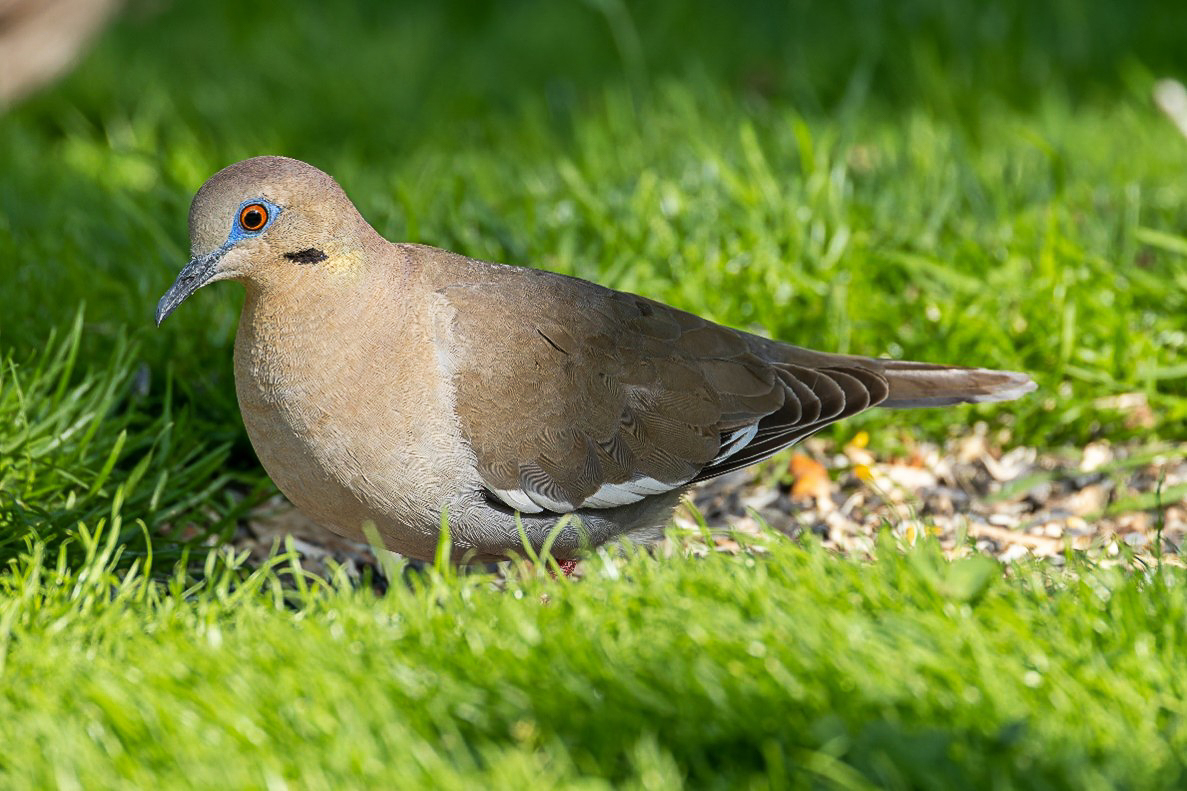
White-winged Dove (Zenaida asiatica)
2023-13-A/B One, Albany, Albany, 24-26 May (Zach Schwartz-Weinstein, Charles P. Dollard, ph Pat Dollard). eBird 24-26 May.
2023-107e (AA) One, Shirley, Suffolk eBird 4 Sep.
2023-106e One, Bridgehampton, Suffolk eBird 31 July.
Many reports of White-winged Doves involve individuals appearing at feeders. This year was no different, with all three individuals appearing at feeders for short stays. The Albany bird was present and well-documented across a few days in late spring, affording a couple of local area birders the chance to observe this rarity. The other two records involve single-day reports of individuals visiting feeders in Suffolk County.
Black-chinned Hummingbird (Archilochus alexandri)
2023-36-A/D One, Randall’s Island, New York, 17-19, 22 Nov (David Jeffrey Ringer, Tim Healy, John Gluth, Scott Dunn, ph D. Ringer, T. Healy, J. Gluth, S. Dunn). eBird 17-30 Nov, 1-2, 5-10, 12-17 Dec.
This hummingbird was documented on social media by Barbara Davaros on 15 Nov at Randall’s Island in Manhattan, and the local birding community was alerted to it as a potential Black-chinned candidate by Tim Healy on 17 Nov. This record represents a long-awaited first state record for this species. Please see the full species account for this record in Healy, 2024.
 Rufous Hummingbird
photo
© John Haas
(click photo to enlarge)
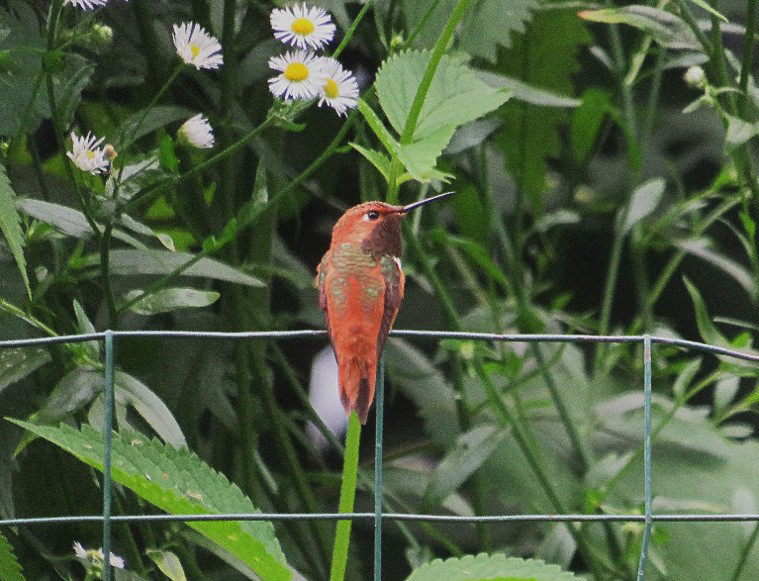
Rufous Hummingbird (Selasphorus rufus)
2023-20-A One, Mamakating Township, Sullivan, 23 Jul (John H. Haas, ph J. Haas). eBird 22-24 July.
2023-108e One, Springs, Suffolk eBird 29 Dec 2023, 15,17 Jan 2024.
2023-109e One, Saugerties, Ulster eBird 24-26 July.
This record details an adult male Rufous Hummingbird that appeared at a feeder in Sullivan County in late July, and was documented by several birders over the course of its short stay. While many Selasphorus hummingbird are often immatures and females requiring careful review of spread-tail photos for identification, this breeding-plumaged male left no concerns regarding its identification—showcasing extensive rusty tones overall and a well-defined notch in rectrix 2. This individual’s late July occurrence highlights this species’ bi-modal vagrancy pattern in the east, with scattered records of short-staying adults still retaining breeding plumage and advanced immatures (presumably that have departed the breeding grounds furthest north) in late summer, followed by a broader spread of immatures and basic-plumaged individuals appearing in the mid-October through December window. An additional bird found in Ulster County in late July coincides with this former mode, while a late December bird from Suffolk follows the latter.
Allen’s Hummingbird (Selasphorus sasin)
2023-34-A/D One, Riverhead, Suffolk, 21 Oct 2023 - 8 Feb 2024 (John Gluth, Tim Healy, Marybeth Zilnicki, Patricia Lindsay, ph J. Gluth, M. Zilnicki, Sean Sime).
Following its discovery on 21 Oct by Marybeth Zilnicki, a Selasphorus hummingbird was thoroughly documented and identified as the first state record of an Allen’s Hummingbird. Thanks to Zilnicki’s incredible hospitality, many birders were able to visit her residence to observe this long-awaited state first while it overwintered in her garden. Please see the full species account for this record, including further details on the challenging identification of this species, in Healy, 2024.
Purple Gallinule (Porphyrio martinicus)
2023-29-A One, Prospect Park, Kings, 15 Oct (Joshua Malbin, ph J. Malbin). eBird 15-31 Oct, 1-5 Nov.
2023-111e (AA) One, Braddock Bay, Monroe eBird 26-30 Nov, 1-9, 11, 12, 16, 25, 29
Dec 2023, 1-3 Jan 2024.
2023-112e (AA) One, Rockland Lake State Park, Rockland eBird 27 Oct.
2023-113e (AA) One, Hawthorne, Westchester eBird 13 Nov.
Purple Gallinule exhibits a very regular pattern of vagrancy in New York with records scattered in most of the regions of the state, across a variety of date ranges. All four of these records are consistent with one of this species’ modes of vagrancy to the Northeast, with all being hatch-year birds at various states of molt in the late fall time period.
Yellow Rail (Coturnicops noveboracensis)
2023-114e One, Conewango Swamp, Cattaraugus eBird 6-7 May.
2023-115e One, Richville, St. Lawrence eBird 17 Oct.
Most Yellow Rail encounters in NYS involve individuals during fall migration, typically in October. This species is typically exceedingly difficult to find, oftentimes requiring extensive marsh-marching or coverage of farm fields where an individual is known to be present. However, on occasion, individuals are discovered in much more conspicuous settings—oftentimes involving birds found in urban settings. The St. Lawrence County bird was discovered in a residential area, feeding on the finder’s manicured lawn. However, the Cattaraugus bird was discovered in an even more unique context, as a singing bird found in spring migration, one of just three spring NYSARC records of this species.
Limpkin (Aramus guarauna)
2023-116e One, West Elmira, Chemung eBird 12, 22-31 Oct, 1 Nov.
Following an unprecedented summer of Limpkin records well north of their typical range during the year prior, 2023 experienced another impressive northward incursion of this species, mainly around the Ohio and Mississippi River Valleys. New York’s second record was found along the Chemung River in West Elmira on 12 Oct by Barb Borrelli. After nearly ten days, the bird was relocated, frequenting the knotweed thickets in a small riverside parkland through 1 Nov.
Black-necked Stilt (Himantopus mexicanus)
2023-11-A One, Babylon, Suffolk, 5, 8 May (Bernie Poelker, ph Marie Poelker).
This individual was well-photographed at a private golf course in a residential neighborhood in southwest Suffolk County. This species has a remarkably consistent pattern of vagrancy to New York, traditionally in spring and early summer, with a nearly even distribution of records between the Upstate and Downstate regions over the past twenty years. With stilts expected as nearly annual, this species was brought up for discussion and ultimately removed from the Review List in November 2023.
 Common Ringed Plover
photo
© Tim Healy
Common Ringed Plover
photo
© Tim Healy
(click photo to enlarge)
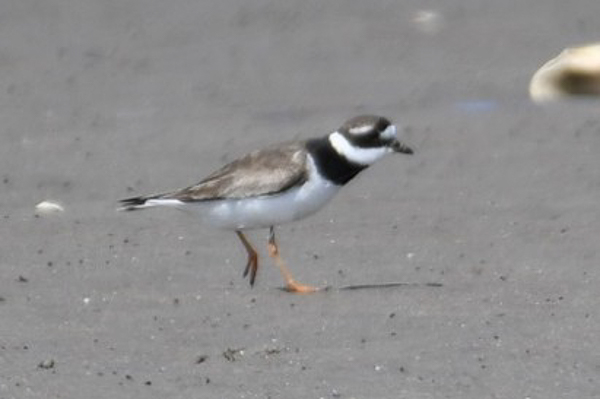
Common Ringed Plover (Charadruis hiaticula)
2023-23-A Up to two, Fire Island – Old Inlet, Suffolk, 22 Aug (Tim Healy, ph T. Healy). eBird 19-28 Aug, 3-6, 8, 10, 12 Sep.
While birding the mudflats around eastern Fire Island’s Old Inlet, Brendan Fogarty, Taylor Sturm, and Fiona Conway discovered an adult Common Ringed Plover among the scores of Semipalmated Plovers that traditionally stage at this site during fall. This bird was a fairly textbook example of this species, showing extensive black on the face and auriculars, a relatively broad breast band, a bold white supercilium, longish and neatly tapered bill, and subtly longer primary projection creating a more tapered impression to the body. Importantly, the finders were also able to obtain crucial images showing the lack of webbing in between the toes. This individual represents the fourth New York State record and the second for Suffolk County. In the following days, this individual proved tough to relocate at times, often requiring extended effort canvassing the extensive mudflats at this location. This individual remained at the site through 28 Aug. Remarkably, a second adult individual was photographed by Elias Markee-Ratner on 27 Aug, while the original bird was still present. This second bird continued at the site through 12 Sep.
Curlew Sandpiper (Calidris ferruginea)
2023-12-A One, Jones Beach State Park, Nassau, 25 May (David Gillen). eBird 24-26 May.
This sharp alternate-plumaged male Curlew Sandpiper was found by Damon Brundage on 24 May on the Short Beach spit at Jones Beach West End. The bird stayed for two additional days, as the first chaseable individual of this species in Nassau County in recent memory. This Palearctic-breeding shorebird has a relatively regular historic pattern of vagrancy to the Northeast, with it being an annual rarity at shorebird hotspots in the Delaware Bay and Delmarva region. In New York, this individual represents the second state record since 2013, and the first for Region 10 within that time frame. Most NYSARC records are from individuals occurring in the late spring (late May through June) or from early fall (July and August), with the majority of records involving adults along the coast or in prime habitat in western New York. While this is the first Nassau County record accepted by NYSARC, it should be noted that this species was mentioned as a fairly regular vagrant to Long Island, with multiple records along the Jones Beach strip during the first half of the 20th century (Bull 1974).
Ruff (Calidris pugnax)
2023-117e (AA) One, Oceanside, Nassau eBird 27 Sep.
This shorebird has a broad historical pattern of vagrancy in New York, and while some years yield the discovery of multiple individuals, it remains rare over the long term with just over twenty-five records in the past two decades. Many of these records are clustered around sites traditionally known for attracting large numbers of migrant Tringa as well as vagrant shorebirds—such as Jamaica Bay and Timber Point downstate, and the Montezuma and Tonawanda wetlands upstate. This individual at the Oceanside Marine Nature Study Area marshes was found by Kevin Rogers and photographed by Michael Friedman. This represents one of the few state records of a juvenile Ruff, an age class that is quite rare and very poorly represented among records in the Northeast.
Western Sandpiper (Calidris mauri)
2023-118e One, Lakeport, Madison eBird 27 Aug.
2023-120e One, Morningside Park, Sullivan eBird 12 Aug.
While Western Sandpiper is a regular passage migrant in the coastal region of New York, it is a very scarce but almost annual species upstate, often found in locations where migrant Calidris peeps concentrate. The Madison County bird was a well-photographed fading adult, still retaining some alternate plumage, whereas the Morningside Park individual was a juvenile.
 Red-necked Stint
photo
© Kennedy Sullivan
(click photo to enlarge)
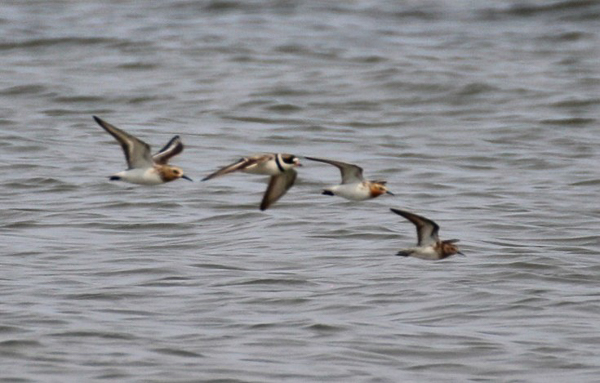
Red-necked Stint (Calidris ruficollis)
2023-42-A One, Sandy Pond, Oswego, 15 Jul (Kennedy Sullivan, ph K. Sullivan). eBird 15 Jul.
While surveying the beach near the Sandy Pond Outlet for shorebirds on 15 Jul, Kennedy Sullivan found an adult Red-necked Stint. This individual was traveling in a small group of shorebirds including a Semipalmated Plover, Least Sandpiper, and Sanderling—the latter allowing for excellent comparison of these species which can appear vaguely similar in fading alternate plumage. This bird was well-photographed during its brief stay, before moving on. This site is one of the premier spots for vagrant shorebirds in the eastern Great Lakes, following on the heels of records of Snowy and Common Ringed Plovers in 2021, among other rarities. This record represents one of very few individuals recorded in the lower 48 away from the coast.
Skua species (Stercorarius species)
2023-121e One, Smiths Point, Suffolk eBird 26 Aug.
An observer photographed a skua during a seawatch from Smiths Point. This bird was reported as a Great Skua, which would be seasonably unusual, and very rare in the state at any season. Many traditional field marks of Great Skua seemed to be apparent in photographs, including a warmer, rufous tone to the bird’s underparts, an impression of a subtly darker hood, and pale feathering to the shoulders. However, the early morning lighting and the distance of the photographs concerned some members that South Polar Skua could not be ruled out. The Committee entertained much deliberation on this individual, and ultimately accepted it in revised form as a Stercorarius species.
Long-tailed Jaeger (Stercorarius longicaudus)
2023-122e One, Long Island Sound 2 nm off Eatons Neck, Suffolk eBird 27 Aug.
Long-tailed Jaeger has a regular pattern of vagrancy to New York, with individuals seen offshore in the pelagic zone or as fall migrants encountered at lakewatches on the Great Lakes. This species is exceedingly rare along the coast, with very few records in the Long Island Sound. This juvenile was well photographed by Brent Bomkamp and Taylor Sturm on a bird-focused boat trip. This represents an important regional record to understanding occurrence and migration patterns of this species in New York. This record confirms that these rare seabirds do in fact appear in Long Island Sound during fall migration, and also raises the question of the mode of occurrence of these individuals—with the likelihood that these birds are active long-distant migrants that have launched overland from the Great Lakes and dropped into the Sound upon arriving on the coast, rather than pelagic birds pushed into the Sound by storms.
Thick-billed Murre (Uria lomvia)
2023-3-A One, Montauk, Suffolk, 12 Feb (Lynne Hertzog, ph L. Hertzog). eBird 21-26, 28-31 Jan, 1, 2, 10-14, 20 Feb.
This record highlights one of many Thick-billed Murres that turned up along the Long Island coastline during early 2023. This specific individual was rather long-staying, ranging from Lake Montauk Inlet to the west side of Fort Pond Bay. This species is prone to incursions during some winters, and shows an affinity for rocky shorelines such as in the Montauk area, as well as around Long Island’s south shore inlets. With over 25 Downstate records over the past ten years, the Committee discussed the status of Thick-billed Murre in November 2023 and removed it from the Review List for Downstate; reports of the species will now only be reviewed from the Upstate region.
Common Murre (Uria aalge)
2023-124e (AA) One, Breezy Point, Queens eBird 1, 7 Jan.
2023-125e (AA) One, Montauk, Suffolk eBird 21 Jan.
2023-126e (AA) One, Montauk, Suffolk eBird 22 Jan.
2023-127e (AA) One, Montauk, Suffolk eBird 21-25, 27-29 Jan.
2023-128e One, Montauk, Suffolk eBird 31 Jan.
While pelagic trips to Long Island’s offshore waters during winter routinely find this species, Common Murre is extremely rare on the immediate coast. Early 2023 was a stand-out season for this species. The Breezy Point bird from early January is one of the few records from shore that far west on Long Island. Additionally, late January produced a spate of records around the Montauk peninsula with four distinct individuals recorded.
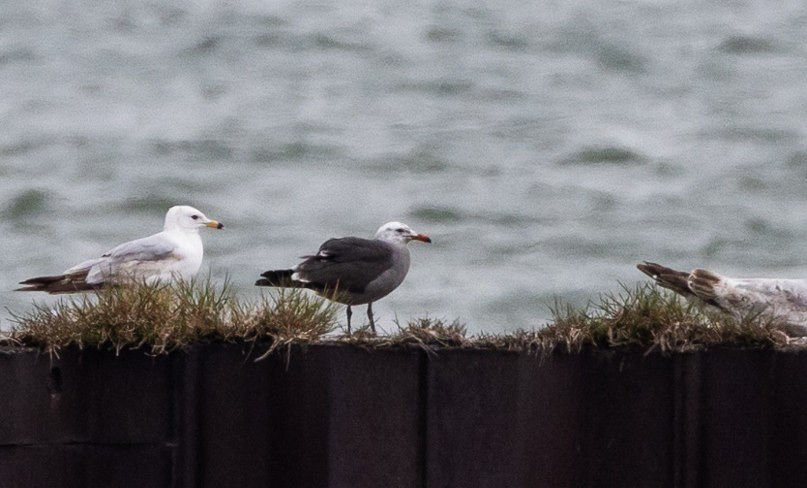 Heermann's Gull
photo
© Jay McGowan
Heermann's Gull
photo
© Jay McGowan
(click photo to enlarge)
Heermann’s Gull (Larus heermanni)
2023-21-A One, Sodus Point, Wayne, 19 May (Jay McGowan, ph J. McGowan). eBird 19-20 May.
Following the occurrence of this species in several nearby states, both along the Atlantic coast and in the Great Lakes region, it was only a matter of time before a Heermann’s Gull was seen within New York State borders. Jay McGowan was the lucky birder to add this species formally to the state list, discovering a subadult individual on 19 May while visiting Sodus Point. Please see the full species account for this record in Healy, 2024.
Franklin’s Gull (Leucophaeus pipixcan)
2023-130e (AA) One, Ossining, Westchester eBird 2 Sep.
This one-day wonder was found by Larry Trachtenberg, and seen by several at a Hudson River park. Photographs of this bird indicate this individual was a second-year bird, with active molt in its outer primaries.
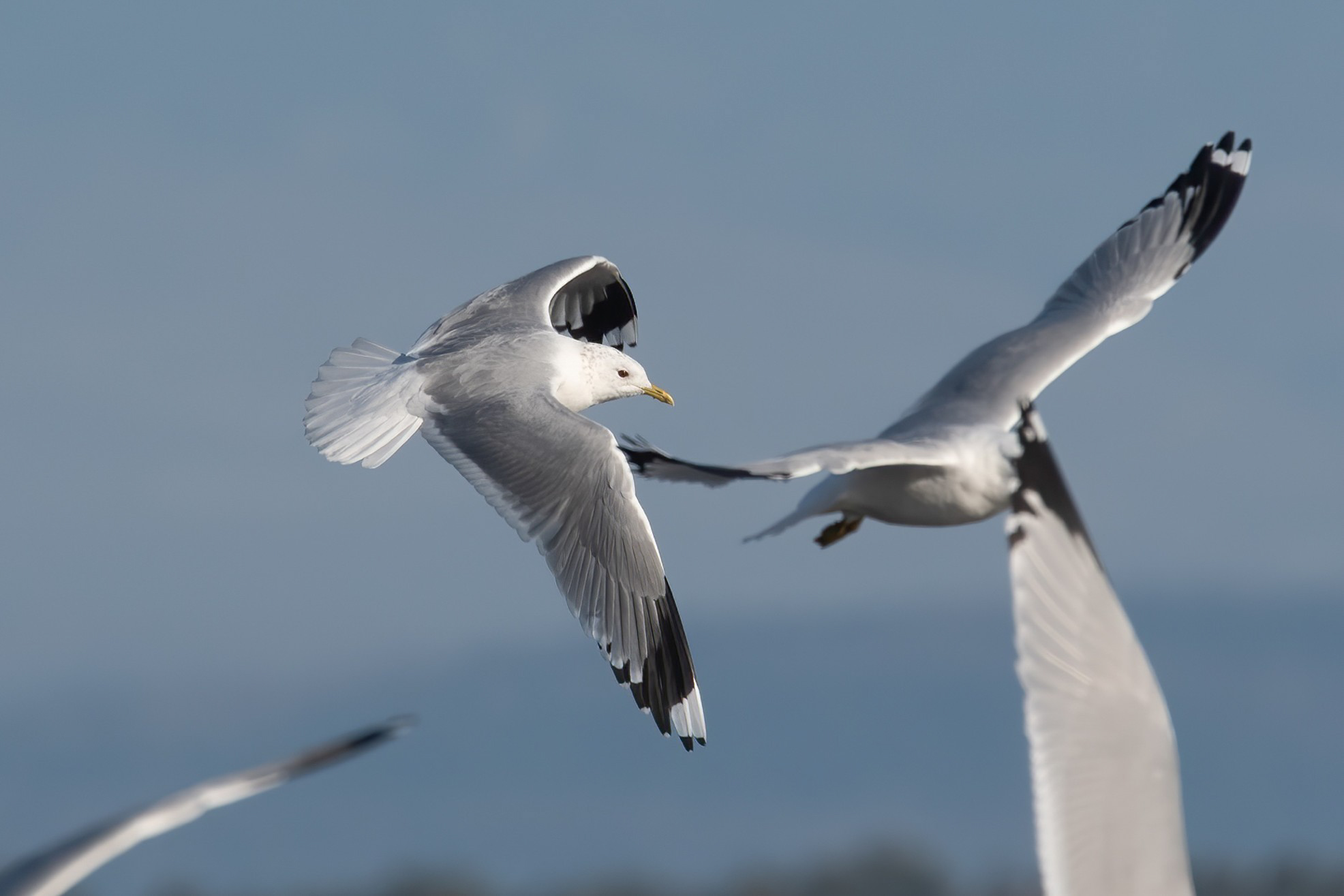 Common Gull
photo
© Derek Rogers
Common Gull
photo
© Derek Rogers
(click photo to enlarge)
Common Gull (Larus canus)
2023-4-A One, Westport, Essex, 9-19 Feb (Derek H. Rogers, ph D. Rogers). eBird 9-12, 15, 19 Feb.
2023-131e One, Olcott Pier, Niagara eBird 12 Feb.
Two Common Gulls were discovered at opposite corners of the upstate region in mid-February. The first was an individual found by Stacy Robinson at Hoisington Brook Outlet in Essex County, one of the region’s top vagrant traps. The submission of this individual involved an expertly crafted report from Derek Rogers, delving into the identification of this gull to species as well as to taxa, as the European subspecies of Common Gull (L.c. canus). Details of the primary pattern were well-studied and documented on this bird, to help eliminate the similar Short-bill Gull (L. brachyrhynchus) and the Asia-breeding kamtschatschensis and henei populations of Common Gull. This represents the first record of this species for Region 7. Another Common Gull was present concurrently, in Niagara County. This individual was found by Willie D’Anna, and later studied by many birders as it spent time in the Ring-billed Gull flock on the Olcott Pier.
Vega Gull (Larus vegae)
2023-133e One, Myers Point, Tompkins eBird 15 Dec.
While surveying roosting larids at Myers Point on the evening of 15 Dec, Jay McGowan discovered a strong candidate for a Vega Gull. In fading light, he was able to obtain photos accurately showcasing its mantle tone across multiple angles, in comparison with adjacent American Herring Gulls (L. smithsonianus), as well as partial spreadwings showcasing the critical outer primary pattern. This record was extensively discussed by Committee, particularly if the partial spreadwing revealed enough of the outer primary pattern, and if other taxa or Larus hybrids could be eliminated. After much discussion, the group was confident these items could be ruled out, and the group accepted the record unanimously. Amazingly, Tompkins County birders found an individual at the Stephenson Rd. dump in late March 2024. This record was postulated that it could be the same individual.
This eastern palearctic-breeding gull had been considered conspecific with American Herring Gull by many authorities, until it was split by eBird/Clements in 2024 and by the AOS in 2025. This represents the long-awaited first record of this species for New York State. While Vega Gull occurs annually in small numbers along the West Coast, it is a much rarer vagrant on the eastern half of continent—it has been documented in several states along the Atlantic Coast as well as around the Great Lakes. With this taxon being elevated to full species status, one may surmise that increased attention towards this taxon may furnish additional records in New York.
Slaty-backed Gull (Larus schistisagus)
2023-1-A One, Morrisonville, Clinton, 11 Jan (Derek H. Rogers, ph D. Rogers). eBird 11-12 Jan.
This adult gull was discovered by Derek Rogers while under special permission to survey gulls at the Clinton County landfill. While the gull was only studied for a relatively short amount of time, a large amount of documentation was able to be acquired and was detailed in the submission, thoroughly discussing each of the primary identification criteria. Two observers who had access to the site documented the bird on the following day. Coverage of the Lake Champlain shore in the following days failed to turn up this individual. For a species that shows a strong affinity for vagrancy in the interior regions of the state, this marks an impressive first record for Region 7.
Glaucous-winged Gull (Larus glaucescens)
2023-14-A One, Pelham Bay Park, Bronx, 31 Mar (Gary Chapin, ph G. Chapin). eBird 31 Mar.
While studying parking-lot gulls along the Bronx coast, Gary Chapin discovered a Glaucous-winged Gull on 31 March. While the identification of Glaucous-winged-type Gulls is notoriously challenging, the Committee unanimously accepted this record, thanks to great documentation as well as thorough insight from several West Coast experts. Please see the full species account for this record in Healy, 2024.
Least Tern (Sternula antillarum)
2023-41-A One, Sandy Pond, Oswego, 28 May (Kennedy Sullivan, ph K. Sullivan, Brandon Brogle). eBird 28 May.
Despite being a common breeder along the coastal region, Least Tern remains a very scarce vagrant to the interior of the state. Kennedy Sullivan discovered this individual during a regular survey of the area around Sandy Pond Outlet. The occurrence of this individual is in line with previous records of this species of the Great Lakes area in New York, with very few records outside of the late May through July time period.
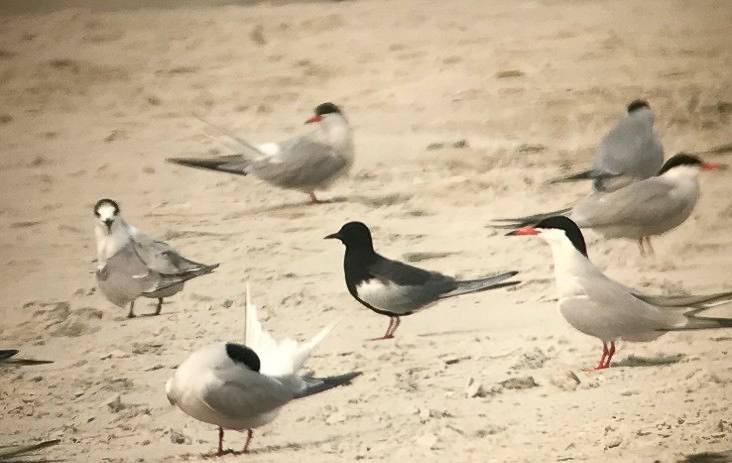 White-winged Tern
photo
© Shai Mitra
White-winged Tern
photo
© Shai Mitra
(click photo to enlarge)
White-winged Tern (Chlidonias leucopterus)
2023-15-A/B One, Nickerson Beach, Nassau, 8 Jun (Shai Mitra, Patricia Lindsay, ph S. Mitra). eBird 8-9 June.
This immaculate, breeding-plumaged White-winged Tern was discovered by tern aficionados Mary Normandia, Patricia Lindsay, Shai Mitra and Seth Ausubel while co-leading a Linnaean Society trip at Nickerson Beach. After its initial detection as it flew in off the ocean, it made another brief appearance visiting the loafing flock of terns as well as a third ephemeral showing for about 20 minutes the following morning. This individual furnished the first 21st century record of this species in New York. This record is the second of Region 10 (with the first being from the barrier beach strip near Cedar Beach in 1991), and the fifth for New York. The other four records come from summer individuals in Monroe County in 1991 and 1997, and Jefferson County in 1992 and 1994 (Lauro 1998; Andrle et al. 2000).
Pacific Loon (Gavia pacifica)
2023-5-A One, Brooklyn, Kings, 28 Feb (Joshua Malbin, ph J. Malbin). eBird 28 Feb.
As a species once acknowledged as a truly rare vagrant along the Long Island coast, occurrence of Pacific Loon has increased in Region 10 over the past two decades. Although historically more regular in New England, and almost annual off Block Island, reports have slowly increased from the eastern end of Long Island—likely stemming from increased observer attention, but potentially due to a shift in vagrancy as well. Within the past few years, this species has been reported on a few occasions further west around the New York Bight. While observed at a distance in the Rockaway Inlet, the observer carefully detailed multiple pertinent field marks in identifying this loon floating amongst a flock of Common Loons. In addition, photos accompanied this report, showcasing the subtly-different, more “serpentine” impression of Pacific Loons, a sharply contrasting vertical demarcation on the neck, and a solidly dark helmet.
Short-tailed Shearwater (Ardenna tenuirostris)
2023-37-A/B One, Derby Hill, Oswego, 7 Nov (Matthew Brown, David Wheeler, ph M. Brown). eBird 7 Nov.
David Wheeler, Matthew Brown and crew discovered this wayward tubenose while lakewatching from Derby Hill on 7 Nov. While the identification of vagrant Sooty vs. Short-tailed Shearwaters is notoriously tough, this individual was able to be confidently identified as a Short-tailed following close review of the photos captured by the observers. Please see the full species account for this record in Healy, 2024.
Leach’s Storm-Petrel (Hydrobates leucorhous)
2023-135e One, Conference House Park, Richmond eBird 24 Sep.
The passage of Tropical Storm Ophelia through the region on 22-24 Sep brought strong, prolonged onshore winds. Multiple Leach’s Storm Petrels were detected in Raritan Bay including this well-described individual from Staten Island.
Long-winged storm-petrel species (Hydrobates sp.) 2023-134e One, City Island, Bronx eBird 24 Sep.
As described above, strong easterly winds associated with the remnants of Tropical Storm Ophelia resulted in the detection of some seabirds pushed into the nearshore waters. This report of a Leach’s Storm-Petrel described a long-winged storm-petrel observed during the height of the storm. While the date and occurrence of other Leach’s Storm Petrels with this storm made this species more likely, the Committee felt this record could not be identified past the genus level and was therefore Accepted in Revised Form as Hydrobates sp.
Scopoli’s Shearwater (Calonectris diomedea)
2023-136e One, pelagic waters 15 mi S of Jones Inlet, Nassau eBird 26 Jun.
2023-138e One, shelf waters near Hudson Canyon, Suffolk eBird 26 Jun.
2023-140e Two, Montauk, Suffolk 25 Aug.
With an impending split that later occurred in 2024, as well as increasing accessibility of identification criteria, there has been more focused attention towards this taxon recently. In 2023, two were recorded on an organized pelagic trip out of Brooklyn, including the first documented record in Nassau County waters. Additionally, two were well-photographed from a shore-based seawatch in Montauk.
Magnificent Frigatebird (Fregata magnificens) 2023-142e One, Mattituck, Suffolk eBird 18 Dec. 2023-143e One, Montauk, Suffolk eBird 18 Dec.
Remarkably, two independent Magnificent Frigatebirds were found in Suffolk on 18 Dec. The first involved an adult photographed by Ben Bolduc on Long Island’s North Fork. Later, that same afternoon, an immature bird was discovered by a local photographer, and independently seen by other birders in the area.
Brown Booby (Sula leucogaster)
2023-19-A One, Coney Island, Kings, 27 Jun (Anthony Ferino, ph A. Ferino). eBird 27 Jun.
2023-28-A One, Coney Island, Kings, 7 Oct (Joshua Malbin). eBird 7 Oct.
2023-30-A One, Little Gull Island, Suffolk, 20 Jul (Frank Mantlik, ph F. Mantlik). eBird 20 Jul.
Birders throughout the northern Mid-Atlantic States have witnessed a dramatic increase in the occurrence of Brown Boobies along the coast in the past decade. For many New York State birders in the downstate region, this species is now almost expected on your year list, particularly for individuals who spend time on the immediate coast. 2023 echoed this same expansion of occurrence with three individuals documented, all from Region 10. Two submissions came from Coney Island, Kings County, with one subadult-type bird in late June documented with photos and video, and an adult in October. Additionally, in Suffolk County, an immature was found along the rocky shoreline of Little Gull Island in late July by Frank Mantlik and a group from Connecticut exploring the island. Given the rapid and continued change of this species’ status in the coastal region of New York, Brown Booby was brought up for discussion to be removed as a review species downstate, and following a vote, will be reviewed from only the Upstate region going forward.
Neotropic Cormorant (Nannopterum brasilianum)
2023-18-A One, Brooklyn, Kings, 24 Jun (Joshua Malbin, ph J. Malbin). eBird 24 June.
2023-148e One, Wolfe’s Pond Park, Richmond eBird 11, 13, 14, 19, 24, 27 June, 2, 3, 5
July, 21, 26, 29 Aug.
Three individual Neotropic Cormorants were recorded this year, all of which were from the southeastern part of the state. One involved a returning bird to the Hudson River waterfront, alternating between sites in Newburgh, Orange County, and Beacon, Dutchess County, from 27 June through 11 Oct. This individual is detailed in the 2022 Annual Report, and captured under NYSARC #2022-194e. The second was Richmond’s first record—an immature discovered at Wolfe’s Pond Park and continuing throughout the summer. Lastly, while kayaking, Joshua Malbin photographed a large roosting flock of Double-crested Cormorants on a sandbar in Jamaica Bay. Later, while reviewing his photos, he discovered he had captured several clear images of a Neotropic Cormorant among the scores of Double-crested Cormorants. Given the tidal-dependent nature of birding in this area, the limited accessibility of the specific site, and the high number of cormorants to sift through in this area, it is not surprising that the Kings County bird was not rediscovered.
White Ibis (Eudocimus albus)
2023-22-A/C One, Stillwater, Saratoga, 31 Jul (Jocelyn Cole, Andrea Denton, Susan M. Beaudoin, ph A. Denton). eBird 31 Jul.
2023-149e One, Walkill River NWR, Orange eBird 8 Sep.
2023-150e One, Penn Yan, Yates eBird 8,9,20 Aug.
Continuing a trend of an increase in the vagrancy of large waterbirds from the southeastern United States in late summer, three widely-separated White Ibis were recorded in the state. The first involved an immature bird discovered by Andrea Denton foraging with several other large waders in a flooded agricultural field known for often attracting migrant shorebirds. This is the second record for the upper Hudson River Valley, with the first occurring in 2017. The other two records of this species also involved juveniles, with one discovered at a farm pond in Yates County and the other at the freshwater marshland on Oil City Rd. in Orange County—the same site where one was recorded in 2011.
Roseate Spoonbill (Platalea ajaja)
2023-151e One, Beacon, Dutchess eBird 22 Aug.
2023-152e One, Seneca Bluffs, Erie eBird 19-31 July, 1-11, 13 Aug.
2023-153e One, Mosher Marsh, Montgomery eBird 11 June.
2023-154e One, Hewlett Bay Park, Nassau eBird 2-10, 12-15, 17, 19, 21-27, 30 Sep, 1-3,
8 Oct. Old Field, Suffolk eBird 9 Oct.
Following multiple records during the summer of 2021, New York experienced another northward incursion of this species during 2023. Four individuals were reported, with long-staying birds in each corner of the state—one outside of Buffalo in Erie County and another in southern Nassau County.
Swallow-tailed Kite (Elanoides forficatus)
2023-157e (AA) One, Prospect Park/Green-Wood Cemetery, Kings eBird 21 Apr.
2023-159e (AA) One, Rochester, Monroe eBird 17, 20, 22-27 Aug.
2023-160e (AA) One, Wilson-Tuscarora State Park, Niagara eBird 26 July. 2023-161e (AA) Up to two, Camillus, Onondaga eBird 21-30 Aug, 1-3, 9 Sep. 2023-155e One, Altamont, Albany eBird 6 May.
2023-156e One, Millbrook, Dutchess eBird 6 Apr. 2023-158e One, Braddock Bay, Monroe eBird 28 July. 2023-163e One, Sodus, Wayne eBird 27 July.
This vagrant from the south has a remarkably regular pattern of vagrancy in the state, often occurring across two main modes – with single birds seen in spring following spates of prolonged southerly winds, as well as individuals found often in upstate areas during the late summer, potentially wayward juveniles or prospecting post-breeding adults. Kites found in this latter context have tended to stay for multiple days in recent years, allowing some of these individuals to be chaseable. NYSARC accepted eight different records of Swallow-tailed Kite in 2023, with individuals occurring in both contexts.
Swainson’s Hawk (Buteo swainsoni)
2023-35-A One, Green-Wood Cemetery, Kings, 3 Feb (Michael Silber, ph M. Silber) eBird 3, 26-28 Feb, 1-5, 7-12, 15-20, 22, 26 Mar, 2 Apr 2023; 16, 26-29 Feb, 1, 3-6 Mar 2024;
15-19, 21-25 Feb, 1-3, 7, 8 Mar 2025. Richmond eBird 8-9 Jan 2023
In early January, a second-year Swainson’s Hawk was found by Maureen Seaberg along the eastern shoreline of Staten Island. This raptor is quite rare downstate, and its discovery resulted in the twitch of this bird by many birders on 8 and 9 Jan. Given its tendency to favor the immediate shoreline of the Hudson River around the Stapleton Waterfront Park, many were afforded close views from the Richmond side of the river as well as more distant views from Brooklyn for those not inclined to brave the Verrazano Bridge traffic. Late in the winter, Michael Silber found an immature Swainson’s Hawk over Green-Wood Cemetery in Brooklyn. This individual settled around the vicinity of a recycling plant near the South Brooklyn Marine Terminal, where it spent the remainder of the spring. Photo forensics of the wear patterns in the outer primaries and rectrices revealed both of the Richmond and Brooklyn sightings to involve the same bird. Amazingly, at the time of the writing, this individual has returned to this spot for its third consecutive winter!
Boreal Owl (Aegolius funereus)
2023-166e (AA) One, Braddock Bay, Monroe eBird 12 Feb.
The “Owl Woods” in Braddock Bay has a remarkable track record for hosting Boreal Owl, often just for single days during the late winter and spring. This year, one was found by Janet and Scott Brooks during an owl survey on 12 Feb.
Black-backed Woodpecker (Picoides arcticus) 2023-167e One, Warrensburg, Warren eBird 14 Oct.
Despite being a resident species to the boreal forest of the Adirondacks, Black-backed Woodpecker is an extremely scarce vagrant outside of this habitat and region. This record represents one of the few records of this species outside of its core range over the past two decades. This species does undergo small southward irruptions, similar to Boreal Chickadee, and has a history of turning up south of their typical breeding range.
Hammond’s Flycatcher (Empidonax hammondii)
2023-43-A One, Rockland Lake State Park, Rockland, 25, 29 Nov (Alan Wells, ph A. Wells). eBird 25, 26, 28-30 Nov.
While checking Rockland Lake for migrant waterfowl on 25 Nov, Della Wells found a small buffy Empidonax flycatcher actively foraging nearby. After spreading word to several local birders, photo documentation as well as audio recordings were obtained and identified this bird as a Hammond’s Flycatcher. This individual was seen by many through 29 Nov. Alan Wells’ thorough report detailed the process of identifying this vagrant, and mentions all classic field marks including bold teardrop-shaped eyering, subtle crested appearance, long primary projection, as well as the large gap in the primary layout between p6 and p7. This is the fifth record of this species for this western montane-breeding species.
Ash-throated Flycatcher (Myiarchus cinerascens)
2023-31-A One, Green-Wood Cemetery, Kings, 21 Oct (Joshua Malbin, ph J. Malbin). eBird 21-27 Oct, 5 Nov.
2023-50-A One, Manhattan, New York, 8 Dec (David Jeffrey Ringer, ph D. Ringer). eBird 2, 5, 6, 8, 9, 11, 12, 15, 17, 18, 30 Dec.
Ash-throated Flycatcher is one of the quintessential Southwest vagrant species expected in late fall in coastal New York. The Committee received two submissions of this species, both from urban parks in New York City. The Green-Wood Cemetery bird was discovered by Richard Fleming, and represented the second recent record of this species for the hotspot, with the prior in 2020. The second individual involved one found by Alan Drogin in New York City’s West Village in remarkably close proximity to where the Couch’s Kingbird was discovered during the winter of 2014-2015. While these were the only two submissions that NYSARC received for 2023, it should be noted that a seemingly large number of Ash-throated Flycatchers (as well as other hallmark Southwestern vagrant species) were recorded in 2023. Fifteen individual Ash-throated Flycatchers were reported across coastal New York, with all but two coming from the five boroughs of New York City. With the regular occurrence of this species over the past two decades in the coastal region of New York, after much careful deliberation, the Committee voted to change this species’ status on the Review List to be only reviewed in the Upstate Region.
Tropical Kingbird (Tyrannus melancholicus)
2023-47-A One, Prospect Park, Kings, 14 Jul (Douglas Gochfeld). eBird 14 Jul.
While birding the area of the peninsula meadow at Prospect Park on a hot summer morning, Jo Dahran discovered a yellow-bellied kingbird. After word was quickly circulated, it was identified as a Tropical/Couch’s by its deep yellow breast and chest, and strongly forked, brownish tail. Despite a large contingent of birders staking out the kingbird, it remained silent. The date, coastal nature of the record, large broad-based bill, and increasing propensity for vagrancy to eastern North America, it was speculated that the bird was likely a Tropical Kingbird. Douglas Gochfeld solicited feedback from Peter Pyle and prepared this report in light of his comments strongly favoring Tropical. Based on the molt limits in the flight feathers, the bird could be aged as a SY (second calendar year) bird, and likely a female. Additionally, details of the wing morphology, including a comparison of the lengths of p10 with p5 as well as the extent of the molt replacement of the flight feathers, strongly favored Tropical Kingbird. While some members initially wanted to discuss the group’s comfort with a non-vocal bird, ultimately, the Committee voted to accept this as the fourth state record of Tropical Kingbird, and the first for Kings County, based on the detailed analysis of the primary and molt pattern captured in the extensive photoset of this individual.
Gray Kingbird (Tyrannus dominicensis)
2023-168e One, Canarsie, Kings eBird 14-17 Nov.
Doug Gochfeld discovered this 2nd Brooklyn record at Canarsie Park, following a historic record from 1930 (Bull, 1974). Over its four day stay, despite prolonged periods when it would disappear, many birders were able to see this species that often proves quite difficult to chase and reluctant to remain faithful to a single site in vagrancy settings.
Scissor-tailed Flycatcher (Tyrannus forficatus)
2023-170e (AA) One, Candor, Tioga eBird 28-30 Apr, 1-3, 5, 6, 10 May.
2023-171e (AA) One, Fair Haven, Wayne eBird 21 Apr.
This infrequent visitor from the southern plains has a regular history of vagrancy to New York, with individuals traditionally occurring in late fall during a time period typically associated with other rarities from the American southwest, as well as during the April to June period during spring. Both 2023 records fit this latter context.
Fork-tailed Flycatcher (Tyrannus savanna)
2023-172e One, Piermont Pier, Rockland eBird 15 June.
This individual found by Linda Pistolesi and photographed by Ari Weiss proved a one-day wonder, as is typical of this species. This bird appeared to be a young, second-year bird sporting a relatively short tail, and extensive amounts of worn brownish flight feathers and coverts retained from juvenile plumage.
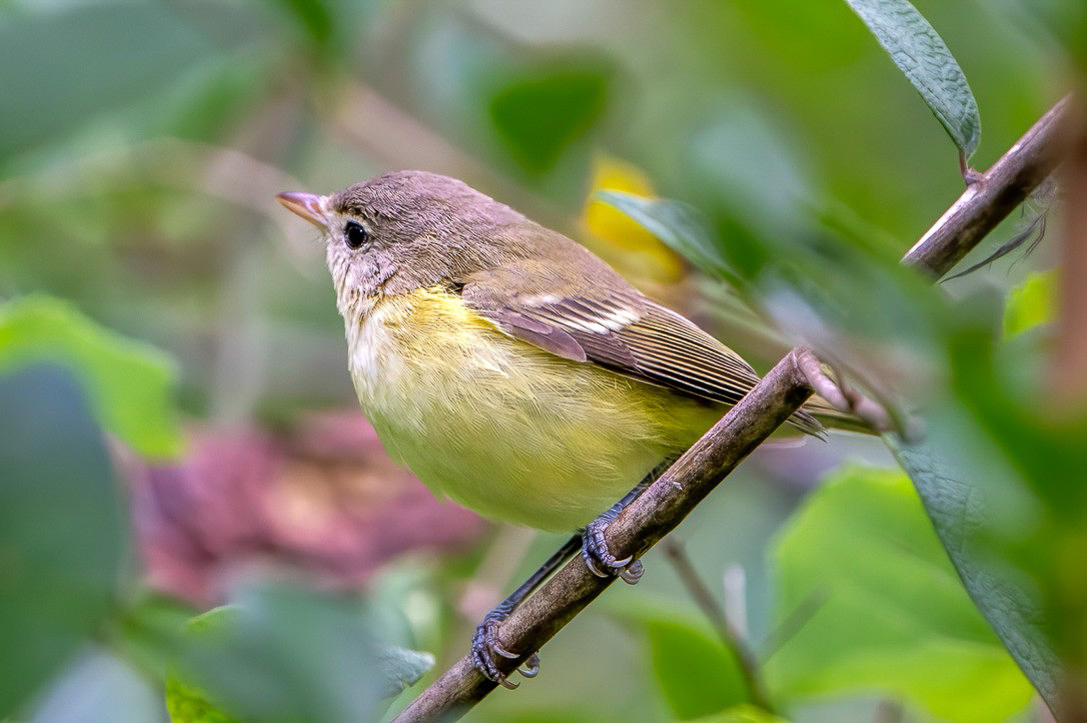 Bell's Vireo
photo
© Ashley Pichon
Bell's Vireo
photo
© Ashley Pichon
(click photo to enlarge)
Bell’s Vireo (Vireo bellii)
2023-27-A One, Glen Cove, Nassau, 16 Sep (Ashley Pichon, ph A. Pichon). eBird 16 Sep. Despite being a fairly regular vagrant to the cedar thickets of eastern Massachusetts and Cape Cod, Bell’s Vireo is still extremely rare in New York State. This individual was discovered and photographed by Ashley Pichon in a small preserve in northern Nassau County. This bird was well-documented, and the Committee was confident that juvenile White-eyed Vireo (a potentially troublesome identification pitfall for this species) could be ruled out. NYSARC has accepted three other records of this species, including one in Central Park, New York in Sep 1996, in Kissena Corridor Park, Queens in Sep 2013, and a singing male in wet scrubby woods in Oneida County in May 2015. Two additional historic records are known with one mist-nested at Tiana Beach, Suffolk in Sep 1959, and the other at Robert Moses State Park, Suffolk in Sep 1970 (Bull, 1974).
Loggerhead Shrike (Lanius ludovicianus)
2023-173e One, Shawangunk, Ulster eBird 14, 15 Sep, 23 Oct, 5, 8, 10-16, 18, 19, 22-27,
29, 30 Nov.
For the second fall in a row, the Shawangunk Grasslands NWR hosted a long-staying Loggerhead Shrike. This former breeder has been rapidly declining along the north edge of its range, and is now considered quite rare at any time of year in the state.
Boreal Chickadee (Poecile hudsonicus)
2023-174e One, Alexandria Bay, Jefferson eBird 2-7, 15, 17, 22, 23 Jan, 8, 11, 12, 14, 15,
17, 22, 26 Feb, 1, 3, 5, 7, 9-12, 15, 18, 19, 25, 28 Mar, 2, 4 Apr.
Similar to Black-backed Woodpecker, this species is quite rare outside of boreal habitat but also occasionally undergoes movements southward. This individual was seen by many during its several-month stay at Grass Point State Park along the St. Lawrence River.
Mountain Bluebird (Sialia currucoides)
2023-175e One, Cedar Beach, Suffolk eBird 8 Dec.
2023-176e One, Heckscher, Suffolk eBird 25-31 Dec, 1-9, 13-15 Jan 2024.
During a fall migration that seemingly brought an above-average number of rare western vagrants to the mid-Atlantic coast, two Mountain Bluebirds were discovered on Long Island – one being a single-day wonder at Cedar Beach, and the second staying from late Dec into 2024 while frequenting the roadside juniper savannah at Heckscher State Park.
Varied Thrush (Ixoreus naevius)
2023-177e One, Rochester, Monroe eBird 5-6 Apr.
The preserves and residential suburbs around the greater Rochester area are recognized as one of the best places along the southern Lake Ontario shore to find rare avian frugivores, such as Bohemian Waxwings and Pine Grosbeaks. This area has hosted several Varied Thrushes in the past, including one that visited a birder’s backyard in early April 2023.
Bicknell’s Thrush (Catharus bicknelli)
2023-178e One, Prospect Park, Kings eBird 13, 16, 18, 19 May.
2023-179e One, Randalls Island, New York eBird 13 May. 2023-180e One, Central Park, New York eBird 14, 16, 17 May. 2023-181e One, Central Park, New York eBird 22 May.
Despite being quite rare away from breeding sites in the high peaks of the Adirondacks and Catskills, Bicknell’s Thrush is a regular migrant through the metropolitan parks around New York City. While documenting this species in migration is tricky, careful observers often are able to confirm the identification with audio recordings of singing birds. All records in 2023 were from New York and Kings Counties during mid May.
Northern Wheatear (Oenanthe oenanthe)
2023-26-A One, Croton Point Park, Westchester, 13 Sep (Steve Rappaport, ph S. Rappaport). eBird 13 Sep.
2023-183e (AA) One, Croton Point Park, Westchester eBird 19-21 Oct.
2023-182e One, Black Dirt Region (general area), Orange eBird 20 Oct.
The first submission received by the Committee involved a well-documented Northern Wheatear discovered by Steve Rappaport and Katherine Moon atop the capped landfill at Croton Point Park, in fading evening light of 13 September. This sight also hosted another record of this species just over a month later. The discovery of this second record on 19 Oct was followed closely by another wheatear found across the Hudson River in the Black Dirt Region of Orange County on 20 Oct.
Smith’s Longspur (Calcarius pictus)
2023-6-A One, Randall’s Island, New York, 14 Apr (Tim Healy, ph T. Healy). eBird 14 Apr.
2023-17-A One, Robert Moses State Park, Suffolk, 9 May (Shai Mitra). eBird 9 May. While Smith’s Longspur is an annual vagrant through the Great Lakes region, it is regarded as a mega-rarity on the East Coast. The occurrence of not one, but two, of this vagrant Calcariid – both breeding-plumaged birds from Region 10 – is quite exceptional. The first of these records occurred in Manhattan, dropping into the appealing Randall’s Island ballfields and found by Mary Beth Kooper on 14 Apr. This breeding plumaged longspur captivated a crowd of lucky observers who arrived on the scene before the ballfields became overwhelmed by dog-walkers and park-goers. The second record was found by Matt Talluto in the dunes near Field 2 at Robert Moses State Park on 9 May. This bird was also a single-day record, though slightly more accommodating, allowing observers to study it as it fed in the dune grass throughout the afternoon until dark. This individual is the second record for Robert Moses and Suffolk County, and the third for Long Island.
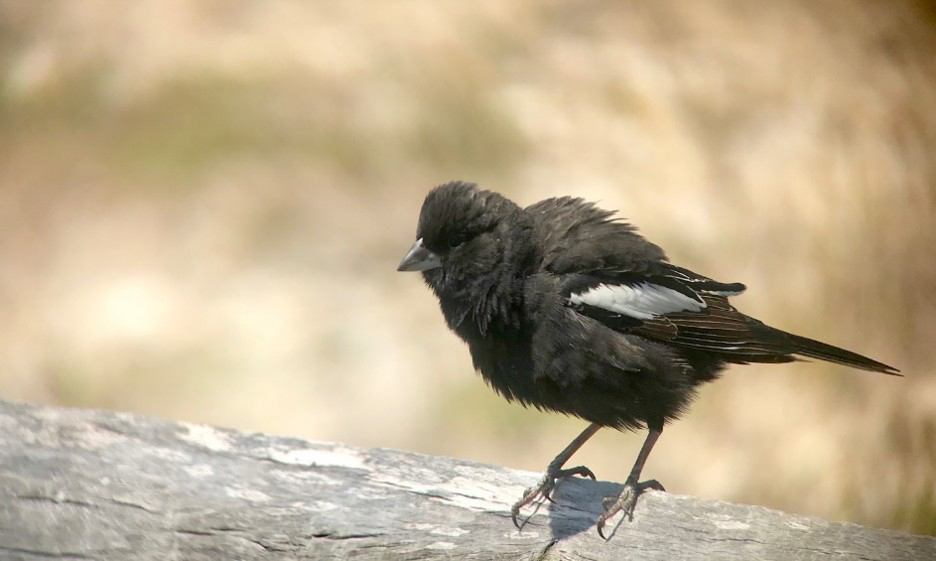 Lark Bunting
photo
© Shai Mitra
Lark Bunting
photo
© Shai Mitra
(click photo to enlarge)
Lark Bunting (Calamospiza melanocorys)
2023-16-A One, Quogue, Suffolk, 14 May (Shai Mitra, ph S. Mitra). eBird 14-16 May.
2023-184e One, Braddock Bay, Monroe eBird 12 May.
Two individuals of this western prairie-breeding vagrant were found in mid-May, each at opposite corners of the state. The first individual was an immature-plumaged male discovered by Kim Steininger at Braddock Bay. It was chased by many local birders on the afternoon of 12 May, showing off in the vicinity of the hawk watch platform at this location. Just two days later, Katie Kleinpeter discovered a sharp-looking male in apparent breeding plumage at the Hot Dog Beach on Dune Road in Suffolk County. This individual was seen by many over the course of three days as it foraged in the short weeds and grasses along the periphery of this gravel beach parking lot, often pausing to sing from the short split-rail fence posts that spanned the lot. Despite the drastic difference in the body plumage of each birds, photo analysis revealed both birds to be second-year males, with molt limits between the replaced jet-black feathers contrasting with retained brownish juvenile feathers in the primaries, secondaries, and rectrices.
“Sooty” Fox Sparrow (Passerella iliaca [unalaschcensis Group])
2023-185e One, Brooklyn Bridge Park, Kings eBird 18 Feb, 23-31 Mar, 1-3 Apr. Douglas Gochfeld discovered this spectacular rarity during a routine survey of Brooklyn Bridge Park on 23 Mar. This individual represents only the fourth record of this taxon for eastern North America, and the second for New York State - the first occurring just a few miles away in Central Park on 14-15 May 2010 (Wilson, 2013). This individual was distinctive, both from eastern forms of “Red” Fox Sparrow (P.i. iliaca/zaboria) and “Slate-colored” Fox Sparrow (P.i.[schistacea Group]), showing uniformly brownish plumage overall, lacking any gray or russet tones to the face and upperparts, and sporting an unmarked upper back and wing panel.
“Gambel’s” White-crowned Sparrow (Zonotrichia leucophrys gambelii)
2023-10-A One, Prospect Park, Kings, 3 May (Joshua Malbin, ph J. Malbin). eBird 3 May.
2023-187e One, Walkill, Orange eBird 21 Apr.
2023-188e One, Gilgo Beach, Suffolk eBird 6 May.
While the vast majority of White-crowned Sparrows that pass through and overwinter in New York are represented by the dark-lored leucophyrys taxon, Gambel’s White-crowned Sparrows have been recorded routinely at traditional overwintering sites for this species and during migration. While the identification can be tricky, the Committee was comfortable accepting three records of this taxon, with each showcasing bright yellow-orange bills and completely pale lores.
Harris’s Sparrow (Zonotrichia querula)
2023-190e One, Dune Rd, Suffolk eBird 28-30 Oct.
While Harris’s Sparrow is regular in upstate New York, often in the context of overwintering birds at feeder settings or during spring, this species is much less regular in the coastal region. This immature bird found by Mike Cooper at the Hot Dog Beach on Dune Road was the first for Suffolk County since 1999, and one of only several records for Region 10. This individual remained at this site for three days, during which many downstate birders were able to see this rarity.
LeConte’s Sparrow (Ammospiza leconteii)
2023-191e One, Salisbury, Herkimer eBird 14-15 Oct.
2023-192e One, Upper Brookville, Nassau eBird 30 Oct.
This furtive Ammospiza sparrow is scarcely detected in the state, with a majority of records coming from fall migrants and overwintering birds in suitable dense grassy habitat in the southern parts of the state. Both reports from 2023 were from October, with the Herkimer County record being notable as one of the few records of this species for the Adirondacks.
Western Meadowlark (Sturnella neglecta)
2023-48-A One, Bush Terminal Piers Park Brooklyn, Kings, 17 Mar (Douglas Gochfeld). eBird 18, 26-28 Feb, 1-7, 9, 10, 12, 16-22, 24-29, 31 Mar, 2, 6, 7 Apr.
On 26 Feb, Linda Ewing found a pale Sturnella meadowlark that was photographed shortly afterwards by Joshua Malbin. The pale and muted appearance of the bird prompted Malbin to circulate photos that reached Doug Gochfeld, who prompted local birders to pursue refinding the bird as it looked like an excellent candidate for Western Meadowlark. Sean Sime and others were able to relocate the bird and obtain better photographs, including excellent flight shots showing the spread tail. In addition to the cold-grayish tones to the plumage, this meadowlark exhibited a central rectrices pattern showing neat crosshatching of both narrow dark and pale bars laterally across the feathers, lacking dark blotching along the feather shafts as seen in Eastern Meadowlarks. Additionally, spread tail images revealed a partially dark R4 (with white restricted to only part of the inner web of this feather) and a fully dark R3 – this pattern is consistent with Western Meadowlark, and eliminating the similarly pale Chihuahuan Meadowlark (S. lilianae), a resident species in the Southwest. Subsequent searches of eBird checklists revealed reports of a meadowlark at this site going back to late December, in a general microregion where Eastern Meadowlarks are very scarce or absent during this time of year. At least one of these reports from 18 Feb was later supported with photographs revealing it to be this vagrant.
Despite several records from the past two decades in western upstate New York of this species, as well as numerous historic records of singing birds on potential breeding habitat dating back to the mid-1900s, Western Meadowlark is a genuine mega-rarity on Long Island and the maritime region in neighboring states. This is only the second documented record of this species from Region 10, with the first found by Taylor Sturm at Crab Meadow Beach, Suffolk on 9 Nov 2019 (D’Anna, 2023).
Bullock’s Oriole (Icterus bullockii)
2023-49-A One, Riverhead, Suffolk, 22 Oct (Marybeth Zilnicki, ph M. Zilnicki)
While watching birds in the garden of her Riverhead residence, and also staking out her feeders for a recently discovered Selasphorus hummingbird, Marybeth Zilnicki noticed an odd oriole visiting her feeders on 22 Oct. She was able to document the visitor, showcasing the oriole’s dark beard, transocular stripe, and bold white wing patch, identifying the first-year male oriole as a Bullock’s. Unfortunately, despite thorough coverage of her yard and feeder setup in subsequent weeks, this bird did not return. This species has a propensity for turning up at feeders during the late fall and winter across the Northeast, although records are rather scarce along the immediate coastal region.
Swainson’s Warbler (Limnothlypis swainsonii)
2023-9-A One, Northport, Suffolk, 25 Apr (Francisco J. Rodriguez, ph F. Rodriguez). eBird 25 Apr.
This elusive warbler species, typically found in swampy bottomlands across the southeast United States, remains a true mega-rarity in New York. Following a spate of multiple records during an incursion in the spring of 2005, only four records have been accepted since, three of which were from Region 10. This individual found in a small suburban park by Francisco Rodriguez was Suffolk County’s first documented record. Despite coverage by multiple birders in the subsequent hours and days, this bird was not able to be relocated.
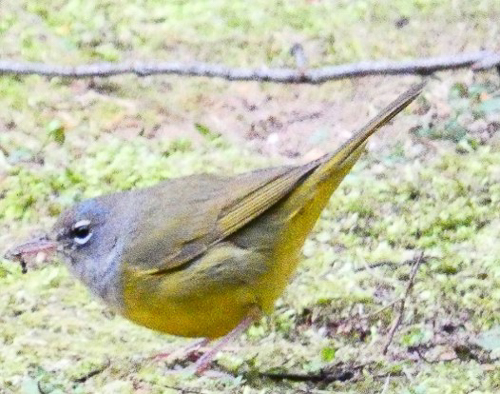 MacGillivray's Warbler
photo
© Julian Batista
MacGillivray's Warbler
photo
© Julian Batista
(click photo to enlarge)
MacGillivray’s Warbler (Geothlypis tolmiei)
2023-44-A One, Riverdale, Bronx, 23 Dec (Julian Batista, ph J. Batista). eBird 23-31 Dec 2023, 1-7 Jan 2024.
2023-195e One, Oakwood Beach, Richmond eBird 10 Dec.
While covering their territory in residential Riverdale, Bronx for the Bronx-Westchester Christmas Bird Count, Julian Batista and Tom Fiore discovered a Geothlypis warbler. After close study revealed its longish tail, whitish throat, and prominent eye arcs, the pair identified it as a MacGillivray’s Warbler. This rarity was twitched by many, as it alternated between times of conspicuously foraging on small private lawns (often in the vicinity of a bright pink children’s car) and covertly skulking in thick weedy vegetation between houses in the local residential community. Earlier in December, another MacGillivray’s Warbler was found and thoroughly described by Dick Veit on Staten Island, with this individual acting more typically and being extremely secretive. This individual was much less cooperative and not refound by birders searching later on 10 Dec or in the following days.
“Audubon’s” Yellow-rumped Warbler (Setophaga coronate auduboni)
2023-51-A One, Jones Beach State Park, Nassau, 9, 12 Dec 2023 and various dates through 24 March 2024 (Shai Mitra). eBird 9-17, 20-23 Dec; 1-6, 8, 10-15, 17-19, 20-22, 24, 27,
28, 30 Jan, 2-5, 9, 15, 19, 25, 26 Feb, 24, 30 Mar 2024.
While birding the Jones Beach strip on 9 Dec, Shai Mitra noticed the distinctive call of an Audubon’s Warbler, which is often tonally unique from the call of the scores of Myrtle Warblers that frequent the barrier beach in fall, coming from the plantings around the Short Beach lot. The bird allowed for some brief views that morning, visually confirming the identification. Over the following months, this warbler was seen by numerous birders as it overwintered at this site through 30 Mar.
Black-throated Gray Warbler (Setophaga nigrescens)
2023-38-A One, Ogdensburg, St. Lawrence, 7 Dec (Troy Parla, ph T. Parla). eBird 8, 9, 15-17, 19-26, 28 Dec 2023, 1, 3 Jan 2024.
On 7 Dec, Troy Parla discovered this bird while birding the shore of the St. Lawrence River, near the outlet of the Oswegatchie River. After identifying it and submitting a formal submission to NYSARC, the presence of this individual was able to be circulated across the birding community. It was enjoyed by many birders over its nearly one month stay and this represents the first record of this species for Region 6.
Townsend’s Warbler (Setophaga townsendi)
2023-40-A One, Forest Park, Queens, 19 Nov (Nelson Pascuzzi, ph N. Pascuzzi). eBird 19 Nov, 27-29 Dec.
2023-197e One, Riverdale, Bronx eBird 30-31 Dec 2023, 1-3, 5, 6, 13, 14 Jan 2024.
2023-198e One, Endicott, Broome eBird 24-26, 28-31 Dec 2023, 1, 2 Jan 2024.
2023-199e One, Rocky Point, Suffolk eBird 15 Sep.
2023-200e One, Springs, Suffolk eBird 29 Dec.
The Committee received one Formal Submission of this species, an individual discovered by Nelson Pascuzzi in Queen’s Forest Park in late November. While the warbler was not refound immediately after Pascuzzi’s sighting, it was rediscovered by Steve Weyman on 25 Dec, and subsequently seen by several birders over the following days. Four other individual Townsend’s records were accepted, all but one of which were also from December. Jay Rand found one in mid-Sep, representing the third record for Suffolk, followed three months later by the county’s fourth record (Sherony 1998).
Western Tanager (Piranga ludoviciana)
2023-39-A One, Jones Beach Coast Guard Station, Nassau, 8-9 Dec (David Gillen, ph D. Gillen). eBird 6-16, 20-22, 24-27, 30 Dec 2023, 1, 3, 5, 7, 8, 10-15, 17 Jan 2024.
2023-45-A One, Putnam Lake, Putnam, 25-30 Dec (Brian Krulish, ph B. Krulish). eBird 29-30 Dec.
The long-staying bird at Jones Beach West End was chased by many birders, and perhaps even more photographers, over its three-week stay. The second was also discovered in December, by Brian Krulish, visiting a residential feeder in the Putnam Lake area for several days. Both of these records are consistent with recent records of this species occurring during the winter season, often in areas such as feeders or metropolitan parks harboring sufficient food for overwintering half-hardy Neotropic migrants.
Black-headed Grosbeak (Pheucticus melanocephalus) 2023-201e One, Willowbrook Park, Richmond eBird 28 Sep.
Black-headed Grosbeak is an extremely rare vagrant in New York, despite a fairly regular pattern of vagrancy of other western montane, long-distance migrants such as Townsend’s and Black-throated Gray Warbler, Townsend’s Solitaire, etc. Shai Mitra detected this individual by its call, distinctive from Rose-breasted Grosbeak and similar to the hollow tone of Downy Woodpecker. The bird was well-described, mentioning the bill pattern, buffy underparts, and pattern of the fine streaking, in addition to having its call recorded.
Blue Grosbeak (Passerina caerulea)
2023-202e One, Swan Lake, Sullivan eBird 26 Nov.
In addition to being reviewable Upstate, this record is also unique for its very late date. Consistent with recent trends of a warmer late fall season, Blue Grosbeak has been recorded into early November in recent years, particularly across the southern areas of the state. This record likely represents the latest date for this species in New York.
2021 Formal Submission Accepted
King Rail (Rallus elegans)
2021-44-A One, Orchard Park, Erie, 28 May (Christopher Bertola, aud C. Bertola)
King Rail is a scarce and localized breeder at several freshwater marshes in the western part of the state. While many records are at breeding sites, this species is occasionally recorded in nocturnal migration. The observer recorded this bird as it passed over their house calling in late May. The recording clearly documented a King/Clapper Rail giving flight calls. As this submission was discussed, a few members mentioned uncertainty as to whether Clapper Rail could be ruled out on the call alone. It was acknowledged that Clapper Rail is an extremely rare vagrant away from the immediate coast, with a majority of records coming from April or early fall. In addition to being a scarce but regular breeder in the western frontier of the state, the general location and date of this report was consistent with previous records of King Rail in active migration. Overall, after much discussion, the Committee was confident that this submission could be accepted.
2012 Reports Accepted in Revised Form
Rufous Hummingbird (Selasphorus rufus)
2012-83-A One, private residence, Henrietta, Monroe, 24 Oct (Jeanne Skelly, ph J. Skelly) eBird 24 Oct, 11 Nov.
This record was reviewed as a Formal Submission. At the time, the Committee did not believe the content and documentation was sufficient to identify the hummingbird to species, and it was accepted in revised form as a Selasphorus hummingbird species (Wilson, 2012). While organizing checklists for the 2012 eBird review round, NYSARC Secretary Gary Chapin noted that some checklists for this record included new evidence and additional documentation, including a checklist from Brad Carlson that showed a detailed spreadtail image. The spreadtail photo showed r2 and r5 quite well and placed the hummingbird well within the range of Rufous. As a result, this record was re-reviewed and the Committee voted to accept this record as a Rufous Hummingbird.
“Eurasian” Sandwich Tern (Thalasseus sandvicensis sandvicensis)
2012-46-A/F One, Sandy Pond, Oswego 25, 29-30 Jul, 6-7, 15, 21, 26 Aug (Bill Purcell, Kevin McGann, Gerald S. Lazarczyk, Kim Hartquist, Dominic Sherony, David Wheeler, ph. B. Purcell, K. McGann, K. Hartquist, D. Sherony, D. Wheeler). eBird 25, 29-31 Jul; 2, 3, 7, 10, 15, 21, 23, 24, 26 Aug; 6 Sep.
On 25 July 2012, Bill Purcell discovered an adult Sandwich Tern molting out of alternate plumage at Sandy Pond in Oswego County. This bird was seen by many during its stay through 6 Sept, and was accepted by NYSARC as the first Upstate record of this obligate coastal species. At the time of this record’s review, the location piqued the interest of several members, three of whom expressed uncertainty on the bird’s identification to subspecies. Ultimately, the Committee believed there was not compelling documentation and published identification criteria to make this determination (Wilson, 2012).
Several papers have since been published delving into the Sandwich Tern taxa. Martin Garner, Ian Lewington, and Jason Crook thoroughly detailed the subspecific identification criteria across age classes in their ground-breaking Dutch Birding article, presenting illustrations, photos of birds in-situ, and a redux of vagrant records of acuflavida in the Western Palearctic. Garner subsequently dove further into this complex in one of his books as well as online (Garner, 2014). More recently, David Sibley published an article in North American Birds thoroughly detailing this complex from a New World perspective, chock full of in-depth illustrations as well as a highlight of multiple inland North American records of Sandwich Tern that appeared to be representative of this taxon. Among these records, Sibley noted that he believed the Oswego bird to be a European Sandwich Tern.
This latter publication prompted a request for re-review. Following circulation of the Dutch Birding and Birding Frontiers text as well as the information cited in Sibley’s article, the Committee unanimously voted to accept this bird as the first state record of this taxa. Multiple features contributed to the assessment of this bird as a European Sandwich Tern, including subtly hooked shape of the outer primaries, the extensive white inner webs of the outer primaries in spreadwing photos, and a more extensive helmet in the fading alternate plumage aspect of this species. Additionally, more cryptic features could be noted such as a more uniformly pale shade to the secondaries and tertials, as well as a subtly thinner bill with the slight gonydeal angle shifted closer to the bill base. This record is one of the very few records for North America. following accepted records from Illinois and Massachusetts, plus additional putative records mentioned by Sibley from Colorado, Connecticut, Quebec, and the Canadian Maritimes. This taxon is certainly one that deserves some consideration while studying vagrant Sandwich Terns, particularly as it could gain full species status at some point in the future.
2023 Formal Submissions Not Accepted
White-winged Dove (Zenaida asiatica)
2023-24-A One, Saratoga Springs, Saratoga, 30 Aug.
An observer reported and photographed a group of Zenaida doves perched on an electrical wire in a residential area of Saratoga Springs. Several key features for this species were not noted in the report, and after careful review of the photographs, the Committee believed all individuals were Mourning Doves.
Ferruginous Hawk (Buteo regalis)
2023-25-A One, New Rochelle, Westchester, 4 Sep.
An immature buteo was photographed in a residential area while hunting local squirrels. While limited notes were included in this submission, members were confident that this hawk was an immature Red-tailed Hawk rather than a rarer species.
Little Egret (Egretta garzetta)
2023-32-A One, Piermont, Rockland, 21 Aug.
This submission came in the form of a second-hand report, thoroughly detailing the identification of a photographed Egretta at Piermont Pier as an adult Little Egret, presumably dispersing from breeding colonies in the Caribbean. It accompanied a well-researched commentary on why several similar candidates such as Snowy Egret, Little x Snowy Egret hybrid, Little Blue Heron, Western Reef Heron and Reddish Egret could be eliminated. While the Committee agreed the latter three options could be ruled out from the photographs, several members were still uncertain if the bird’s identity could be narrowed further. The photos accompanying the report depict a dark-lored Egretta with fully dark legs and pale yellowish feet; however, the early evening lighting and resolution of the photos were not optimal for detailed analysis. While the overall field marks were similar to those shown in Little Egret, Snowy Egrets occasionally show dark or grayish lores, both in breeding plumaged adults and in young juveniles; this feature can also vary on lighting and impression in photos. While the legs of this bird appeared fully dark and several members had the impression this bird was an adult, some were of the opinion that there was not enough to confidently age the bird and an older juvenile Snowy Egret could not be ruled out. After extended discussion, the Committee agreed that while the photos were suggestive, there was not enough to confidently accept this individual as a Little Egret, without a better assessment of the loral color and shape, bill length, and age.
Elaenia species (Elaenia sp.)
2023-33-A One, Brooklyn, Kings, 30 Jul.
On 30 July, a birder photographed a new world flycatcher species in a Brooklyn park. Although at the time of discovery the observer believed the bird was most likely a Least Flycatcher, eBird sleuths pointed out the bird was odd based on its worn plumage condition, apparent slight head tuft, and suggested that the bird could be an Elaenia. Despite a large amount of coverage on the following day failing to turn up the bird, a lengthy online discussion occurred in the ensuing days as to the bird’s identification. The Committee received this submission of the bird as an Elaenia species and spent quite a bit of time discussing this bird’s identity. The bird was strikingly odd, with several members mentioning the ragged crest and overall impression of the bird seemed off for an Empidonax. A few members brought up that pale tips to the lesser coverts could be potentially visible in some photos, but it was tough to tell if this feature was not just an artifact in a few photographs. The most compelling feature was pale edges along the emarginated section of the primaries – a mark described as a key way to separate Empidonax species from Elaenia species (Sibley, 2022). This field mark was apparent in some but not all of the photos, and several members were uncertain if this was just a result of the lighting in the photographs. Additionally, one member shared photos in the Macaulay Library seeming to show this feature of pale edging of the primaries in two different Least Flycatchers. Ultimately, while this report was intriguing and made a compelling case that this bird could be an Elaenia, the Committee concluded that this could not be confirmed as such and an odd worn Empidonax could not be confidently ruled out.
2014 Formal Submission Not Accepted
Iceland Gull (Larus glaucoides glaucoides)
2014-140-A One, Shinnecock Inlet, Suffolk, 2 Feb 2014.
This submission involved a first-winter Iceland Gull, that sported pale plumage overall, limited markings on the tertials, and very pale primaries. Identification of this subspecies is quite tough given the spectrum of variation among young Iceland Gulls. The Committee acknowledged this bird seemed to be fairly pale, and gave the impression of a petite bird with a neatly rounded head. Several members expressed that it did not seem like a “classic” glaucoides, with the tertials appearing a bit too marked for this subspecies. Additionally, while the pictures of the spreadwing were not from the most optimal angle, this bird did not appear to exhibit the pattern of primaries becoming progressively paler as you move outward towards p10 – a field mark typical of glaucoides Iceland Gulls. Ultimately, the Committee voted not to accept this report, given the extensive variation within this species and caution towards accepting borderline individuals resembling this tricky taxon.
1997 Formal Submission Not Accepted
White-tailed Eagle (Haliaeetus albicilla)
1997-75-A One, Lakeshore Marshes WMA, Wayne, 28 Mar.
This submission was well-prepared and quite thorough, in both its written description and research. The observer was fairly detailed in their account, addressed potential pitfalls of similar species, and suggested this could be the same White-tailed Eagle reported by observers at Derby Hill four years prior. Several Committee members had some reservations regarding this report. The original field notes were prepared three days following the original sighting, and only after consultations with articles. The observer also mentioned that they were still not certain enough to report the bird, but became more confident after reading Byrne and Brinkley’s article in 2017. Additionally, it seems that 3rd and 4th year Bald Eagles might be most similar to this individual and while the observer mentioned in the submission how these were ruled out, some Committee members were not confident these age classes could be confidently eliminated. After much discussion, the Committee voted to not accept this record.
Formal Submission Contributors:
Julian Batista, Susan M. Beaudoin, Christopher Bertola, Brandon Brogle, Matthew Brown, Gary Chapin, Jocelyn Cole, Andrea Denton, Charles P. Dollard, Pat Dollard, Elda Dow, Scott Dunn, Anthony Ferino, David Gillen, Janet Gillen, Thomas Gillen, John Gluth, Douglas Gochfeld, John H. Haas, Tim Healy, Lynne Hertzog, Brian Krulish, Patricia Lindsay, Joshua Malbin, Frank Mantlik, Jay McGowan, Shai Mitra, Mark Moody, Frank Montresor, Troy Parla, Nelson Pascuzzi, Ashley Pichon, Bernie Poelker, Marie Poelker, Steve Rappaport, David Jeffrey Ringer, Francisco J. Rodriguez, Derek H. Rogers, Stephen Savage, Zach Schwartz-Weinstein, Michael Silber, Sean Sime, Michael Stubblefield, Kennedy Sullivan, Ellen Valle, Matthew Voelker, Alan Wells, David Wheeler, Glenn Wolford, Marybeth Zilnicki.
2010-2022 eBird Records Accepted by NYSARC
2017-178e Scopoli’s Shearwater One, shelf waters near Coimbra Wreck, Suffolk eBird 22 Jun.
2017-179e Scopoli’s Shearwater One, shelf waters near Coimbra Wreck, Suffolk eBird 22 Jun.
2017-180e Scopoli’s Shearwater One, shelf waters near McMaster Canyon, Suffolk eBird 5 Jul.
2017-181e Scopoli’s Shearwater Four, inshore waters off Montauk, Suffolk eBird 15 Jul. 2017-182e Scopoli’s Shearwater Three, inshore waters off Montauk, Suffolk eBird 23 Jul.
2015-189e Scopoli’s Shearwater Ten, inshore waters off Montauk, Suffolk eBird 12 Jul. This is the state high count.
2015-190e Scopoli’s Shearwater One, inshore waters off Montauk, Suffolk eBird 19 Jul.
2015-191e Scopoli’s Shearwater One, inshore waters off Montauk, Suffolk eBird 9 Aug.
2015-192e Scopoli’s Shearwater One, inshore waters off Montauk, Suffolk eBird 9 Aug.
2012-200e “Black” Brant One, Pelagic, Suffolk eBird 28 Jan.
2012-201e (AA) Tufted Duck One, Huntington, Suffolk eBird 17-20, 22-25, 28, 29, 31
Dec 2012, 1-4 Jan 2013. Cold Spring Harbor, Nassau eBird 13-17, 19, 20, 27 Jan, 11, 16,
19, 24, 25, 27 Feb, 1, 2, 4, 5, 9, 17, 20-31 Mar, 1-10 Apr 2013.
2012-202e White-winged Dove One, Braddock Bay, Monroe eBird 24 May.
2012-203e (AA) White-winged Dove One, Pleasant Plains, Richmond eBird 10-29 Feb, 1-31 Mar, 1-30 Apr, 1-27 May.
2012-204e Rufous Hummingbird One, Central Park, New York eBird 14, 15, 17-19, 21 Nov.
2012-205e Rufous/Allen’s Hummingbird One, Pleasant Plains, Richmond eBird 3-6 Oct. The Committee believed this report of a Rufous Hummingbird could not be confidently identified to species, and accepted it in revised form as a Rufous/Allen’s Hummingbird.
2012-206e Rufous Hummingbird One, Brooktondale, Tompkins eBird 1 Oct.
2012-207e Curlew Sandpiper One, Montezuma, Seneca eBird 24-26 Jul.
2012-208e Baird’s Sandpiper One, Montezuma, Seneca eBird 21, 22 May.
2012-209e Western Sandpiper One, Buffalo, Erie eBird 10 Sep.
2012-210e Western Sandpiper One, Montezuma, Seneca eBird 14, 19, 22, 23 Sep.
2012-211e Western Sandpiper Two, Montezuma, Seneca eBird 1 Nov.
2012-212e Western Sandpiper One, Moriches Inlet, Suffolk eBird 14, 16, 24, 28, 30 Jun.
2012-213e Long-tailed Jaeger One, Robert Moses State Park, Suffolk eBird 2 Jun.
2012-214e Long-tailed Jaeger One, East Hampton, Suffolk eBird 2 Jun.
2012-215e Common Murre Six, Long Island Sound off Orient, Suffolk eBird 11 Jan.
2012-217e Common Murre One, Long Island Sound off Orient, Suffolk eBird 22 Jan.
2012-218e Common Murre One, Long Island Sound off Orient, Suffolk eBird 18 Feb.
2012-220e Common Murre One, Long Island Sound off Orient, Suffolk eBird 16 Dec.
2012-221e Common Murre Two, Montauk, Suffolk eBird 17 Dec.
2012-223e “Thayer’s” Iceland Gull One, Robert Moses State Park, Suffolk eBird 19 Oct.
2012-225e Leach’s Storm-Petrel One, Gravesend Bay, Kings eBird 30 Oct.
2012-229e Leach’s Storm-Petrel One, Bellport, Suffolk eBird 30 Oct.
2012-230e Leach’s Storm-Petrel One, Montauk, Suffolk eBird 31 Oct.
2012-231e Leach’s Storm-Petrel One, Myers Point, Tompkins eBird 30 Oct.
2012-232e Scopoli’s Shearwater One, inshore waters off Montauk, Suffolk eBird 1 Aug. This is presumably the first documented record in eBird for NYS.
2012-235e American Three-toed Woodpecker One, Floodwood, Franklin eBird 8 Jul.
2012-236e American Three-toed Woodpecker One, Ferd’s Bog, Hamilton eBird 16 Feb.
2012-237e American Three-toed Woodpecker One, Stillwater, Herkimer eBird 26 Apr.
2012-238e Fork-tailed Flycatcher One, Oceanside, Nassau eBird 19 Sep.
2012-241e Bicknell’s Thrush One, Etna, Tompkins eBird 30 Sep.
2012-242e Dark-eyed Junco (cismontanus) One, Monkey Run, Tompkins eBird 21-22 Jan.
2012-244e “Oregon” Dark-eyed Junco One, Wolcott, Wayne eBird 22, 23, 26 Dec 2012;
27 Jan; 2 Feb 2013.
2012-246e LeConte’s Sparrow One, Edgemere, Queens eBird 15 Dec.
2012-247e LeConte’s Sparrow One, Dryden, Tompkins eBird 17-19 Nov.
2012-248e Brewer’s Blackbird One, Montauk, Suffolk eBird 11 Nov.
2012-249e “Audubon’s” Yellow-rumped Warbler One, Sunken Meadow State Park,
Suffolk eBird 5, 7, 9, 11, 13, 14, 26, 27 Dec 2012, 8 Jan 2013.
2012-250e Blue Grosbeak One, Bashakill, Sullivan eBird 4 Oct.
2012-251e Blue Grosbeak One, Spencer, Tompkins eBird 8 May.
2011-200e (2011-157-A) “Western” Greater White-fronted Goose One, Montauk, Suffolk, 20 Nov 2011, 18 Mar 2012 (Shaibal S. Mitra, ph S. Mitra). eBird 20 Nov, 30 Dec. The Committee reviewed both a formal submission and eBird reports of this Greater White-fronted Goose. This subspecies is extremely rare downstate with very few documented records, one of which involves an individual from this site in 2014.
2011-201e Trumpeter Swan Two, Yaphank, Suffolk eBird 18, 21, 23 Dec, 1, 2, 5, 8 Jan
2012.
2011-202e Tufted Duck One, Cold Spring Harbor, Suffolk/Nassau eBird 4-7 Jan.
2011-204e (AA) White-winged Dove One, Sheepshead Bay, Kings eBird 27-28 Nov.
2011-206e Rufous Hummingbird One, East Hampton, Suffolk eBird 30-31 Aug, 2, 3, 18 Sep.
2011-209e Western Sandpiper One, Fair Haven, Cayuga eBird 28 Aug.
2011-210e Western Sandpiper One, Rochester, Monroe eBird 30 Aug.
2011-213e Western Sandpiper One, Montezuma, Seneca eBird 16 Oct.
2011-214e South Polar Skua One, Sea Cliff, Nassau eBird 28 Aug.
2011-215e California Gull One, Riga, Monroe eBird 24 Mar
2011-217e Sooty Tern Up to Three, East Hampton, Suffolk eBird 28 Aug.
2011-218e Sooty Tern Two, Watermill, Suffolk eBird 28 Aug.
2011-219e Sooty Tern Two, Eatons Neck, Suffolk eBird 28 Aug.
2011-220e Sooty Tern Two, East Hampton, Suffolk eBird 28 Aug.
2011-221e Sooty Tern Two, Montauk, Suffolk eBird 28 Aug.
2011-225e Bridled Tern One, Veterans Memorial Pier, Kings eBird 28 Aug.
2011-226e Bridled Tern One, Tobay, Nassau eBird 28 Aug.
2011-227e Bridled Tern One, Riverside, New York eBird 28 Aug.
2011-228e Bridled Tern Up to Seven, East Hampton, Suffolk eBird 28 Aug.
2011-229e Bridled Tern One, Gilgo Beach, Suffolk eBird 28 Aug.
2011-230e Bridled Tern Up to Six, Watermill, Suffolk eBird 28 Aug.
2011-231e Bridled Tern Up to Three, Mecox, Suffolk eBird 28 Aug.
2011-232e Bridled Tern Up to Seven, Montauk, Suffolk eBird 28 Aug.
2011-233e White-tailed Tropicbird One, Fort Washington Park, New York eBird 29 Aug.
2011-234e Yellow-billed Loon One, Fair Haven, Wayne eBird 30 Oct. This is the fourth state record, all from upstate.
2011-236e Leach’s Storm-Petrel Up to Eight, Watermill, Suffolk eBird 28 Aug.
2011-237e Leach’s Storm-Petrel One, Montauk, Suffolk eBird 28 Aug.
2011-238e Leach’s Storm-Petrel One, Springs, Suffolk eBird 28 Aug.
2011-241e Tricolored Heron One, Bashakill, Sullivan eBird 28 Apr.
2011-242e White Ibis One, Captree, Suffolk eBird 6 Aug.
2011-243e White Ibis One, Dune Rd, Suffolk eBird 6 Sep.
2011-244e American Three-toed Woodpecker One, Old Inlet, Hamilton eBird 7 Jul.
2011-245e “Black” Merlin One, King Ferry, Cayuga eBird 30 Jan. Second documented state record, following the first record found by Tom Johnson nearby in Cayuga Co. (Wilson 2017).
2011-247e Common Redpoll (rostrata/islandica) One, Dryden, Tompkins eBird 21 Feb.
2010-200e Western Grebe One, Lemon Creek, Richmond eBird 21 Mar.
2010-201e Purple Gallinule One, Montezuma, Seneca eBird 16 Oct.
2010-202e Baird’s Sandpiper One, Walkill, Orange eBird 10-12 May.
2010-204e Western Sandpiper One, Pikes Beach, Suffolk eBird 31 May.
2010-205e Franklin’s Gull One, Robert Moses SP, Suffolk eBird 27 Oct. Second of the day around Fire Island Inlet, with an adult bird found later at Captree SP (Wilson 2010).
2010-207e American Three-toed Woodpecker Two, Moose River Plains, Hamilton eBird 17 July.
2010-208e Boreal Chickadee One, Coney Island, Kings eBird 9 Nov.
2010-209e Boreal Chickadee One, Hamlin Beach, Monroe eBird 23 Oct.
HOW TO SUBMIT REPORTS
Advice on how to prepare and submit a report is provided on the NYSARC pages within the NYSOA web site: http://nybirds.org/NYSARC/index.htm. Although it may go without saying that photographs and/or audio recordings of the reported bird(s) can be vitally important to getting a record accepted by the Committee, it cannot be emphasized enough that a thorough written description of the bird(s) and the circumstances of the observation, as well as other pertinent details, can also propel a record to acceptance. Unfortunately, eBird reports are frequently very short on details and when those reports also lack hard evidence, such as photos or audio recordings, it becomes difficult for the Committee to accept them. This highlights an important distinction between NYSARC and eBird. Some eBird reports are accepted by eBird reviewers in large part because the observer is considered experienced. While NYSARC may consider the observer’s experience, we require accepted records to have archived documentation that can be reviewed by anyone in the future. As such, some reports from very experienced observers that have few or no substantial details and which were accepted by eBird reviewers, will not be accepted by NYSARC.
On the NYSARC website, there is a list of species requested for review by NYSARC (The Review List) as well as illustrated copies of previous annual reports. The Committee is very grateful to Carena Pooth (NYSOA Web Master) for updating and continuously improving the NYSARC web site. A downloadable reporting form allows observers to compose a written report. Documentation (written reports, photographs, audio recordings) and any other correspondence for the Committee can also be sent via email to the NYSARC Secretary, Gary Chapin, at: nysarc44@nybirds.org. As a last resort, you can also use regular mail to get your report to Gary:
Gary Chapin, 125 Pine Springs Drive, Ticonderoga, NY 12883
Submitted on behalf of the New York State Avian Records Committee:
Willie D’Anna (Chair), Gary Chapin (Secretary), Shawn Billerman, Thomas W. Burke,
Patricia J. Lindsay, Michael McBrien, Curt McDermott, Jay McGowan
LITERATURE CITED
Andrle, R. F., et al. 2000. Report of the New York State Avian Records Committee for 1997. The Kingbird Vol 50(1): 19-25.
Bull, J. 1974. Birds of New York State. Doubleday/Natural History Press.
Craves, J. A., N. M. Anich. 2023. Status and distribution of an introduced population of European Goldfinches (Carduelis carduelis) in the western Great Lakes region of North America. NeoBiota Vol 81: 129-155.
D’Anna, W., et al. 2023. Report of the New York State Avian Records Committee for 2019. The Kingbird Vol. 73(3): 166-180.
D’Anna, W., et al. 2024. Report of the New York State Avian Records Committee for 2020. The Kingbird Vol. 74(2): 106-133.
eBird. An online database of bird sightings created by the Cornell Lab of Ornithology, Ithaca, NY, and launched in 2002. https://ebird.org/home
Garner, M., I. Lewington, and J. Cook. 2007. Identification of American Sandwich Tern (Sterna sandivicensis acuflavida). Dutch Birding 29: 273-287.
Garner, M. 2014. Birding Frontiers Challenge Series: Autumn. Privately published. pp.
45-49.
Healy, T. 2024. Special Report of the New York State Avian Records Committee: Addition of 17 New Species to the New York Checklist. The Kingbird Vo1. 74(3): 218-235.
Lauro, A. J. 1998. Bull’s Birds of New York State. E. Levine, ed. Cornell University Press.
p. 304.
Mitra, S. S. 2011. Tropical Storm Irene in New York State. The Kingbird Vol. 61(4): 292-298.
NYSARC Online Database. An online database of rare bird sightings in New York State. https://nybirds.org/NYSARC/HistData/NYSARCthru2022updated2024_0717.pdf
Sherony, D. F. 1998. Bull’s Birds of New York State. E. Levine, ed. Cornell University Press. p 467.
Sibley, D. A. 2023. “European” Sandwich Tern in North America: Notes on Occurrence and Identification. North American Birds 74 (1): 16-25.
Sibley, D. A. 2022. Identifying small flycatchers: Separating Elaenia and Empidonax by wing pattern. Sibley Guides.
https://www.sibleyguides.com/2022/04/identifying-small-flycatchers-separating-elaenia-and-empidonax-by-wing-pattern/
Terry Chesser, R., et al. 2024. Sixty-fifth Supplement to the American Ornithological Society’s Check-list of North American Birds. Ornithology Vol. 141(3).
Terry Chesser, R., et al. 2025. Sixty-sixth supplement to the American Ornithological Society’s Check-list of North American Birds. Ornithology Vol. 142(3).
Wilson, A. C., et al. 2004. Report of the New York State Avian Records Committee for 2002. The Kingbird Vol. 54(4): 282-313.
Wilson, A. C., et al. 2012. Report of the New York State Avian Records Committee for 2010. The Kingbird Vol. 62(2): 94-127.
Wilson, A. C., et al. 2014. Report of the New York State Avian Records Committee for 2012. The Kingbird Vol. 64(3): 178-210.
Wilson, A. C., et al. 2017. Report of the New York State Avian Records Committee for 2013. The Kingbird Vol. 67(4): 271-301. |


